
The short answer
| Dreadmoor | Dredge | |
|---|---|---|
| Developer | Dream Dock (Kyrgyzstan) | Black Salt Games (New Zealand) |
| Publisher | Digital Vortex Entertainment | Team17 |
| Release | Early Access, November 9, 2026 | Released March 30, 2023 |
| Perspective | First-person | Top-down |
| Setting | The Submerged Lands, after a human-made collapse | A mysterious archipelago with a buried history |
| Core loop | Fish, process, trade, upgrade the trawler, survive the water | Fish, sell, upgrade the boat, dredge for secrets |
| Pressure | Fuel, hull damage, night visibility, hold management | Panic, darkness, time of day |
| Combat | Axe and harpoon, real-time | No combat system; avoid threats |
| Price | $19.99 in Early Access | $24.99 base, often discounted |
| Platforms | Windows PC via Steam | PC, PlayStation, Xbox, Switch |
| Status | Early Access planned for 6–12 months | Complete game with paid expansions |
That table is the honest summary: the two games occupy the same shelf, but they are built differently enough that "copy" is the wrong word and "unrelated" is also wrong.
Why the comparison follows Dreadmoor everywhere
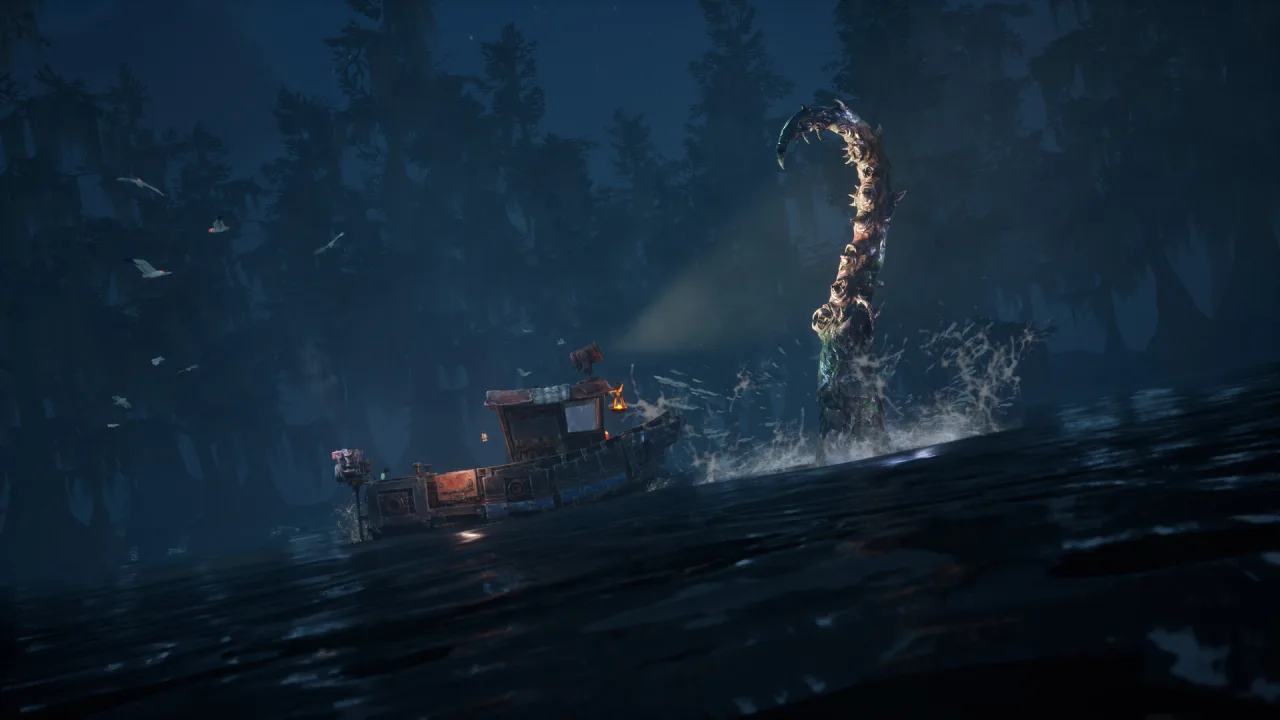
Both games are about a small boat, bad water and a catch that should not exist. Both use a fishing loop as the economic spine, both upgrade the boat, both use an inventory that forces decisions about what to keep, and both treat the water as a place where something is watching.
Dreadmoor's first trailer made the comparison unavoidable. Its interface cues, the glowing eyes in dark water and the tentacle-adjacent branding read, to a lot of people, like Dredge with a bigger budget. Reddit threads accused it of copying; Vice wrote a piece questioning whether the game was even real. That context is part of the comparison whether the studio likes it or not.
The counter-evidence is the demo. A pre-rendered pitch cannot be played for five hours; a build that asks you to pump fuel, clean polyps off a hull and pull against a fish can. The demo exists, it is free, and it is the fastest way to judge the question for yourself.
The camera changes the work
Dredge is played from above. You see the boat, the water and the danger at a distance, and the game abstracts the physical work: you choose a spot, you play the fishing minigame, you sort the hold. The camera keeps you in command.
Dreadmoor puts you inside the boat. You hold the rod, you watch the line, you pump fuel by hand and you place ingredients into a workbench one at a time. The fishing guide describes the consequence: the fight is about reading tension and stamina from the first-person view, not watching a bar from a safe distance.
That single change alters the tone. Dredge's horror is in the map and the story; Dreadmoor's horror is in the fact that you cannot see behind you while you are reeling.
Fishing: tension versus timing
Dreadmoor's fishing is a physical exchange. You cast, wait for a bite, then pull against the fish while managing line tension and the fish's stamina. The fishing guide covers the timing, and the bait guide covers why the wrong lure produces nothing.
Dredge's fishing is a timing minigame: a moving marker, a target zone, and a button press. It is deliberately simpler, because Dredge wants you to spend your attention on navigation, panic and the story rather than on the rod.
Neither approach is better. They produce different sessions: Dreadmoor asks for your hands, Dredge asks for your nerve.
Survival pressure: fuel and hull versus panic
Dreadmoor's announced pressures are mechanical. The trawler burns fuel, the hull takes damage from creatures and debris, and night reduces what you can see. The fuel page and the hull repair page cover those systems in detail.
Dredge's pressure is psychological. Its panic system punishes staying out after dark and being far from safety, and the game uses the resulting distortions to make the world less trustworthy. There is no fuel gauge doing the same work.
Dreadmoor has not announced a sanity or panic meter. If you are coming from Dredge and expecting that specific mechanic, the honest answer is that Dreadmoor's tension comes from resource management and visibility instead.
Danger and combat
This is one of the clearest mechanical splits. Dreadmoor has real-time combat: an axe, a harpoon, and creatures that can damage the boat. The combat guide covers when fighting is correct and when fleeing is cheaper.
Dredge does not have a combat system. Its threats are avoided, outrun or survived, not fought. That makes Dredge's danger more about planning and Dreadmoor's more about execution under pressure.
Structure: Early Access versus a finished game
Dreadmoor enters Early Access on November 9, 2026 with the full core loop, one major region and the complete story, according to the publisher. Dream Dock plans to stay in Early Access for six to twelve months and add content during that period. The Early Access roadmap separates what is promised from what is merely expected.
Dredge is finished. It shipped in March 2023, has two paid expansions and a complete beginning-to-end campaign. If you want a game you can finish this week and never wonder about a patch, that matters more than any mechanical difference.
Is Dreadmoor a sequel to Dredge?
No. Dredge was developed by Black Salt Games, a New Zealand studio, and published by Team17. Dreadmoor is developed by Dream Dock, a Kyrgyzstan studio, and published by Digital Vortex Entertainment. They share no characters, no continuity and no publisher.
The confusion is understandable because the store tags, screenshots and tone overlap. But "spiritual successor" is a marketing description, not a continuity claim, and Dredge's story is self-contained.
Is it a copy?
The fair version of the argument is this: Dreadmoor takes the fishing-horror premise, the boat-upgrade loop and the "mutated catch" aesthetic from the same well as Dredge. If that is all you need to call something a copy, the label will stick.
The fair counter-argument is that the execution diverges at the first interaction. First-person handling, fuel logistics, hull maintenance, real-time combat and a physical crafting bench are not Dredge's systems. The studio has said in interviews and Reddit AMAs that Dredge was an inspiration rather than a blueprint, and the demo is consistent with that claim: it feels like a different game to hold.
What the demo cannot settle is originality of story or long-term structure. Early Access will.
Which should you play?
- Play Dredge if you want a complete, top-down game with a finished story, console support and a low sale price. It is the safer purchase today.
- Play Dreadmoor if the first-person handling is the appeal, you want combat and boat maintenance, and you are comfortable with an Early Access game that will change.
- Play the Dreadmoor demo first if you are unsure. It is free, it runs on the same technology as the launch build, and it answers the "is this just Dredge?" question faster than any article can.
The demo walkthrough covers the full quest chain if you want to see how much game the demo actually contains. The price page covers what Early Access costs, and the platforms page explains why Dreadmoor is PC-only while Dredge is on consoles.
Sources
Sources checked November 5, 2026. Prices are US Steam prices on that date and will change.
- Dreadmoor on Steam — developer, publisher, release date, single-player, Windows-only listing.
- Dredge on Steam — developer, publisher, release date, platforms, $24.99 base price.
- Dreadmoor Early Access press release — November 9 date, $19.99, Early Access scope, full story.
- Vice: There's Something Fishy About Dreadmoor — the trailer skepticism and the Dredge comparison.
- Game-Meta: Meet Dream Dock — summary of the studio's interviews and Reddit AMAs describing Dredge as an inspiration.
- Dredge on Wikipedia — console platforms, expansions and release history.